How to find out if you’re better off with a meter or set rates.
With some huge price increases on water bills in 2025, any way to save some money is going to be a good thing. SO is a water meter the answer?
Well, the answer depends mainly on how much water you actually use. Sometimes they can save you a decent chunk of cash every year, but others will see their bills rocket when one is installed.
I’d always been unsure about them, but now after a good few years of being charged for the water I use, I can share with you whether it was worth it for me, and how to estimate what one could mean for you.
Plus I’ve some tips to help you reduce your usage and bring bills down further.
Some articles on the site contain affiliate links, which provide a small commission to help fund our work. However, they won’t affect the price you pay or our editorial independence. Read more here.
Who can get a water meter?
For most homes in England and Wales you can ask your water company to fit a water meter. It’s normally completely up to you. However, some water companies, including Thames Water, have made it compulsory.
It’s free to get a water meter installed in England and Wales. You’ve usually got one to two years after installation to compare costs. If you find it’s costing you more, you can switch back to your standard rates. That is of course unless you’re in an area with compulsory metering.
Some water meters are smart meters that let you monitor use. Others need to be read by the water company and you have to wait for your bill to find out charges.
In Northern Ireland your water rates are already included and in Scotland a water meter installation isn’t free.
Should you get a water meter?
So how do you know if one is good for you? Well, non-metered water is charged based on the size of your house – a bit like council tax. Water meters on the other hand measure exactly how much you are using.
A simple rule of thumb to decide which is for you is if there are more bedrooms than there are people living in a house. If so then you’re likely to be paying more than you need to for your water.
If you want to get a more accurate picture, then there’s also an online calculator. That’s what I looked at before deciding whether to give the meter a go.
The calculator will give you a rough total which is estimated on exactly how many showers you have a week, how many times you use the dishwasher, washing machine, baths, how many times you flush the toilet and so on.
The problem is if you have more people in a house than there are bedrooms or people use water a lot – maybe you’re a keen gardener regularly using the hose – then it’s very likely to cost you more money.
Did it save us cash?

Andy’s analysis
Because only two of us are living in a four-bedroom house there was always a good chance we’d be paying less with a water meter.
Back in the summer of 2018, before we switched, our annual bill was £590. The calculator estimated a new cost of £376 a year via a meter, a huge saving of £214. So it was a no-brainer for us to give this a try.
Frustratingly, we couldn’t read the meter ourselves, and there was no bill at all for the first 13 months!! When it arrived the total for that first year was pretty close to the estimate at £390. A little more than the estimate, but we were still saving a fair wedge of cash each year.
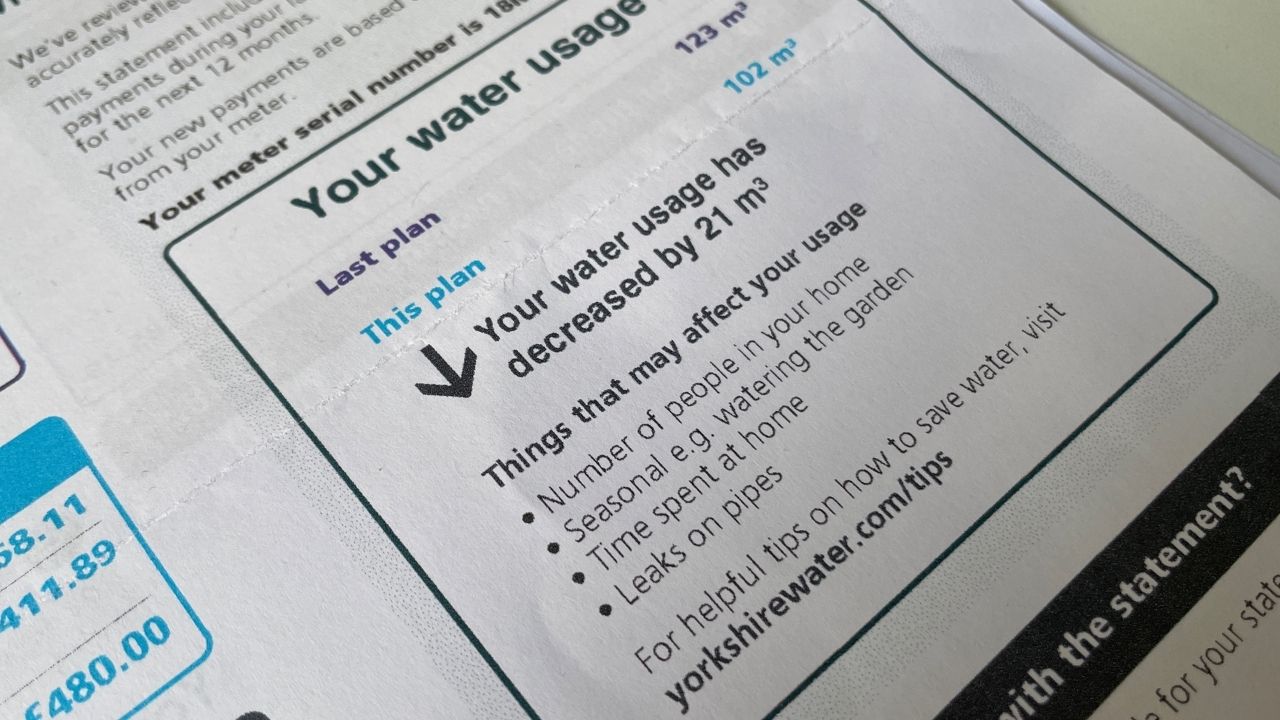
However, since then, our water usage – and our bills – have varied. Water usage in 2019 was 102m3, but a massive 123m3 in 2020 (probably due to lockdowns). This meant our bill jumped up to £480. Still a decent saving, but not as large.
In 2022, usage was down to 78m3, costing £324. Then it went up again in 2023 to 91m3 and a total of £425. The figure for 2024, the last statement I received, was 92m3 at a cost of £481.
That’s still a big annual difference of more than £100 compared to our non-metered charge from back in 2018! And since prices for unmetered rates have increased every year, the actual saving will be far higher.
When I think back to my previous house, where I lived for close to eight years, if we’d switched then and got similar savings we could have been close to a grand better off.
But – bear in mind my savings are based on the water usage of two people. I’ve played around with the calculator to estimate the cost if more people lived here. It’s still cheaper with three adults, but it could easily be £70 or £80 extra each year with four people than the fixed rates. So it’s important you check for your own circumstances.
Get the best of our money saving content every week, straight to your inbox
Plus, new TopCashback customers get a high paying £18 welcome offer

How to reduce costs when you have a water meter
If you’ve already got a meter because you’ve moved into a house with a meter, had one for more than two years or compulsory installations are happening, well there are still ways you can cut your bills and it’s very very simple. You use less water.
There are obvious things you can do. For example, turning off the tap when you clean your teeth, or it’s making sure that you don’t necessarily flush the loo every single time. There’s that phrase “if it’s yellow let it mellow, if it’s brown flush it down”. It might sound a bit rough… but it’s true that you don’t necessarily need to flush it every time – and that will save some water.
Free water saving devices
In fact there are all sorts of things you can get which can help you use less water. From special bags that go in the water cistern to reduce the flush through to shower timers. There are even slow release crystals you can put in plant pots which mean you don’t need to water them as often. And they are free from most water companies.
For most providers you can go via Save Water Save Money and enter your postcode. You’ll see what’s available and what you can order for free. Alternatively, just google your water company and see if they offer anything for customers.
Our podcast
Listen to Cash Chats, our award-winning podcast, presented by Steve Alderton and Editor James Andrews.
Episodes every Monday.